
With the rising price of crude oil, the gap between the desired selling price and the actual selling price -- referred to as under-recovery -- is up to Rs 190 crore (Rs 1.9 billion) a day. The solution is to raise retail prices, an unpopular move.
For the first time in seven months, state-run fuel retailers are making losses on selling diesel and together with negative returns on petrol, LPG and kerosene, the companies may lose Rs 38,700 crore (Rs 387 billion) in revenues this year.
Indian Oil, Bharat Petroleum and Hindustan Petroleum raised avitation turbine fuel price by Rs 3,949 to Rs 36,252 per kilolitre in Delhi effective Monday midnight, an IOC official said. International crude oil prices have firmed to a seven-month high of $72 per barrel on hopes of demand revival in US.
The firms were till last month selling diesel at a profit of 32 paise a litre, which helped them partly neutralise the losses on the sale of petrol, domestic LPG and kerosene. But from Monday, IOC, BPCL and HPCL are at breakeven on diesel while they lose Rs 3.68 a litre on petrol, Rs 69.49 per 14.2-kg LPG cylinder and Rs 12.65 on every litre of kerosene, industry sources said.
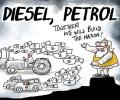
Petrol and diesel prices are unlikely to be increased despite firming raw material costs because of upcoming general elections next year, Moody's Investors Service said. Three state-owned fuel retailers -- Indian Oil Corporation (IOC), Bharat Petroleum Corporation Ltd (BPCL) and Hindustan Petroleum Corporation Ltd (HPCL) -- which control roughly 90 per cent of the market, have kept petrol and diesel prices on freeze for a record 18 months in a row. This is despite the raw material (crude oil) cost surging last year, leading to heavy losses in first half of 2022-23 fiscal year before easing oil prices propelled them to profitability.
The Oil and Natural Gas Corporation will pay Rs 852 crore (Rs 8.52 billion) for subsidising petrol and diesel during January-March quarter but state gas utility GAIL India has been spared from the subsidy burden.
With Indian Oil, Hindustan Petroleum and Bharat Petroleum projected to lose Rs 200,000 crore (Rs 2,000 billion) in revenues on sale of petrol, diesel, domestic LPG and kerosene below import cost, industry sources said a hike in the range of Rs 2 to 5 per litre appears on the cards.
State-run oil companies on Wednesday raised prices of aviation turbine fuel, or ATF, for the third time in a month, this time by about 6.7 per cent, in step with international rates, which are firming up.
Reliance has shut all of its 1,432 petrol pumps in the country after sales dropped to almost nil as it could not match the subsidised price offered by public sector competition. Public sector currently sells petrol at a loss of Rs 13.97 a litre and diesel at a discount of Rs 20.97 per litre. This revenue loss is made up by the Government through issue of oil bonds. Private firms were not entitled for the subsidy and priced fuel from their pumps at Rs 8-10 a litre higher.
Public sector oil firms plan to set up over 4600 petrol stations and 907 LPG sale agencies in the current fiscal, Petroleum Minister Mani Shankar Aiyar said on Thursday.
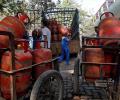
Petroleum and oil marketing companies raised the price of commercial liquid petroleum gas (LPG) cylinders by Rs 350.50 per unit and domestic LPG cylinders by Rs 50 per unit with immediate effect from Wednesday.
The Congress Party on Monday strongly opposed the government's decision to divest stake in Hindustan Petroleum Corporation and Bharat Petroleum Corporation saying that hydrocarbon is part and parcel of the strategic sector.

There has been a sharp recovery in the headline corporate earnings in the April-June 2023 quarter (Q1FY24), after a dismal showing by early bird companies. The combined net profit of the 983 listed companies that have declared their quarterly results, so far, was up 64.7 per cent year-on-year to record a high of Rs 2.68 trillion in the first quarter, but growth in earnings remained lopsided because most of the incremental gains came from a handful of companies. Moreover, the quarterly numbers showed a continued slowdown in revenue growth.
The government is considering allowing private firms to sell subsidised domestic cooking gas LPG, the Lok Sabha was informed on Thursday.

Investors are showing some interest in the downstream energy cycle. Refiners and marketers, especially the public sector (PSU) oil marketing companies (OMCs) could see a revival of marketing margins. Lower crude oil and gas prices may also improve margins in industries like paints, logistics, synthetic fabrics, plastics, and fertilisers. In the medium-term, however, there could be a supply overhang affecting OMCs as new refining capacities are scheduled to be commissioned, especially in China, and this may lead to a drop in the refining margins as capacity would be surplus to demand until and unless there's a pick-up in global growth.
The government will take home Rs 4,022 crore (Rs 40.22 billion) by way of interim dividend bonanza declared by the state-owned oil companies in the last one week.
Indian Oil, Bharat Petroleum and Hindustan Petroleum recorded profit on the sale of petrol and diesel, the first in three years, on the back of falling international oil prices, industry sources said. The three firms are moping up a neat Rs 11.99 per litre margin on petrol and Rs 4.13 a litre on diesel sale.
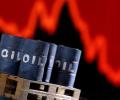
After Reliance Industries Ltd and its partner bp plc of the UK, Nayara Energy - the nation's largest private fuel retailer - has started selling petrol and diesel at Re 1 less than the fuel sold by state-owned retailers, officials said. While state-owned Indian Oil Corporation (IOC), Bharat Petroleum Corporation Ltd (BPCL) and Hindustan Petroleum Corporation Ltd (HPCL) continue to hold prices despite a drop in international rates, private fuel retailers have started passing on the benefit to consumers. "To further stimulate domestic consumption and cater to local customers better, we have introduced a Re 1 discount in our retail outlets until the end of June 2023," a spokesperson for Nayara Energy said.
The government owned oil companies have proposed to pay interim dividend for the financial year 2006-07
Oman Oil Company has offered to buy a 26 per cent stake in the upcoming refinery at Bina for $250 million (Rs 1,200 crore), reversing an earlier decision not to increase its stake beyond the 2 per cent it currently owns.

The Centre could further moderate its divestment target for 2024-25 (FY25), as it does not expect large receipts from asset sales - except some ongoing strategic ones, including IDBI Bank, which could spill over into next financial year. Also, it may drastically reduce its FY24 divestment target of Rs 51,000 crore. "We are still evaluating the Budget estimates for FY25. "New big-ticket asset sales are unlikely.
Bharat Petroleum Corporation Ltd and Hindustan Petroleum Corporation Ltd have restarted their Mumbai-based refineries, which were partially shut following incessant rains.

As much as 8 billion rubles (about Rs 1,000 crore) of dividend income belonging to Indian oil firms is stuck in Russia after the Putin administration clamped down on dollar repatriation, officials said on Friday. Indian state oil firms have invested $5.46 billion in buying stakes in four different assets in Russia. These include a 49.9 per cent stake in Vankorneft oil and gas field and another 29.9 per cent in TAAS-Yuryakh Neftegazodobycha fields.
Last month, Indian Oil Corp, Bharat Petroleum and Hindustan Petroleum were losing Rs 390 crore (Rs 3.9 billion) per day on sale of petrol, diesel, kerosene and domestic LPG. This month, losses have come down to Rs 352 crore (Rs 3.52 billion) per day, an industry official said.
Indian Oil Corp, Bharat Petroleum and Hindustan Petroleum have seen revenue losses on sale of petrol, diesel, LPG and kerosene coming down to Rs 450 crore (Rs 4.5 billion) per day from Rs 600 crore (Rs 6 billion) per day, industry sources said. The basket of crude that India buys has averaged $114.37 a barrel this month as against the July average of $132.47 per barrel.
The India story got stronger on the global arena with the country expanding its presence on the elite list of Fortune Global 500 companies, as the PSU banking major State Bank of India has become the sixth domestic firm to feature in the league.
Petroleum Minister Ram Naik said the terms and conditions of the strategic sale of HPCL and and public offer in BPCL would be worked out by a core group of secretaries on divestment.
A decision on sale of government equity in HPCL, BPCL could be delayed beyond the Dec 7 deadline with PetroMin Naik stating he has no idea about the next CCD meet.\n\n\n\n
The Oil and Natural Gas Corp has asked the government to review the scheme of sharing of liquefied petroleum gas and kerosene subsidy with upstream firms and said the scheme should not be extended beyond March 2004.
Reliance Industries, the country's largest LPG producer, will be spared from footing the Rs 7,200 crore (Rs 72 billion) bill for the one year freeze in LPG and kerosene prices, despite rising cost.
The under-realisation on fuel sales incurred by the oil marketing companies is projected to rise by 14 per cent to around Rs 760 crore (Rs 7.6 billion) per day in the first fortnight of July from Rs 680 crore (Rs 6.8 billion) per day in the second fortnight of June.
Supreme Court on Friday issued notices to the Union government and public sector oil majors Hindustan Petroleum Corporation and Bharat Petroleum Corporation on a public interest litigation challenging the Centre's decision to privatise.
India imports 73 per cent of its crude oil import needs and the cost of imports would spiral after crude inched closer to a record $125 per barrel, while rupee touched its 13-month low, official sources said. The basket of crude oil India imports was at $120.65 per barrel on Thursday, a 91 per cent jump over the last fiscal's lowest price of 62.91 dollars recorded on May 9, 2007, official sources said.
